


Nigeria’s small and medium enterprises are not a niche part of the economy, they are the economy. SMEs make up roughly 96% of all registered businesses in the country, contribute close to 48% of national GDP, and account for as much as 84% of total employment. Yet despite carrying that much weight, the sector has a brutal survival rate: research consistently shows that about half of Nigerian SMEs fail within their first year, and more than 95% don’t make it past five years. The reasons cited most often aren’t lack of ambition or lack of customers,they’re finance access, poor financial management, and infrastructure costs eating into thin margins.
This is the backdrop against which an SME Finance Toolkit matters. It isn’t a luxury add-on for businesses that have “made it.” It’s the missing infrastructure for businesses trying to survive their first five years,a bundled set of templates, trackers, and guides that gives a small business financial structure without the cost of hiring a full finance department.
What a Good SME Finance Toolkit Actually Includes
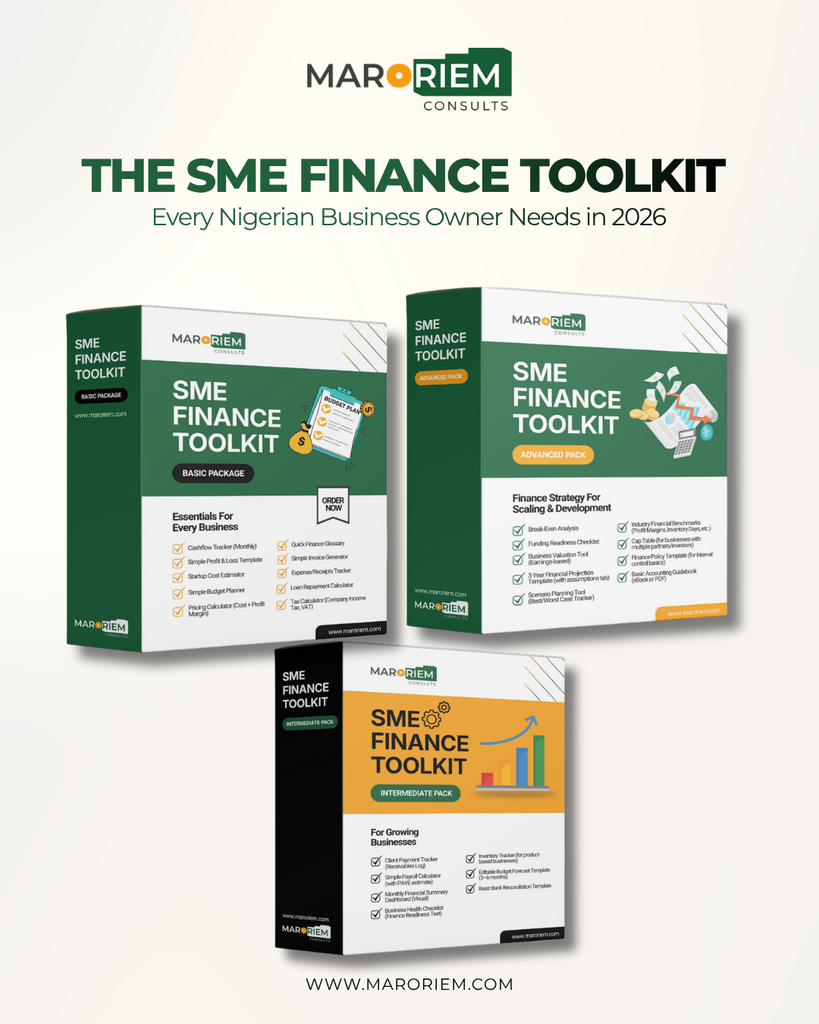
The Maroriem Consults SME Finance toolkit isn’t a single spreadsheet, it’s a system. At minimum, it gives you:
- A bookkeeping template for sales and expenses
- An invoice generator that produces professional, consistent invoices
- A startup cost estimator for founders still in the planning stage
- A payroll and pension calculator that handles PAYE and statutory deductions correctly
- A cash flow tracker to monitor what’s actually in the bank versus what’s owed
- A tax-readiness checklist aligned to Nigeria’s current filing obligations
Instead of building each of these from scratch, or discovering you need one only after a problem has already occurred, you plug into templates that have been tested against real Nigerian business conditions.
There’s also a growth dimension that’s easy to overlook. Every meaningful next step for an SME, a business loan, an investor conversation, a government tender, or simply understanding whether last month was actually profitable,depends on organized financial records. Founders who can pull up accurate numbers in minutes look more credible to banks and partners than those who need two weeks to “sort out the books” first.
Structure Beats Capital
Given that access to finance is already one of the top reasons Nigerian SMEs fail, the businesses that survive and scale in 2026 won’t necessarily be the best-funded ones. They’ll be the ones with the cleanest systems, founders who treated financial organization as a day-one priority rather than a fire to put out later, once a lender or auditor forces the issue.
An SME Finance toolkit is the fastest, most affordable way to build that foundation, especially for founders without an accounting background and without the budget to hire one yet.
Ready to get organized? Get the Maroriem Consults SME Finance Toolkit today and start managing your sales, expenses, payroll, and tax records like a pro, no accounting degree required.